

Why Change Feels Harder During Menopause
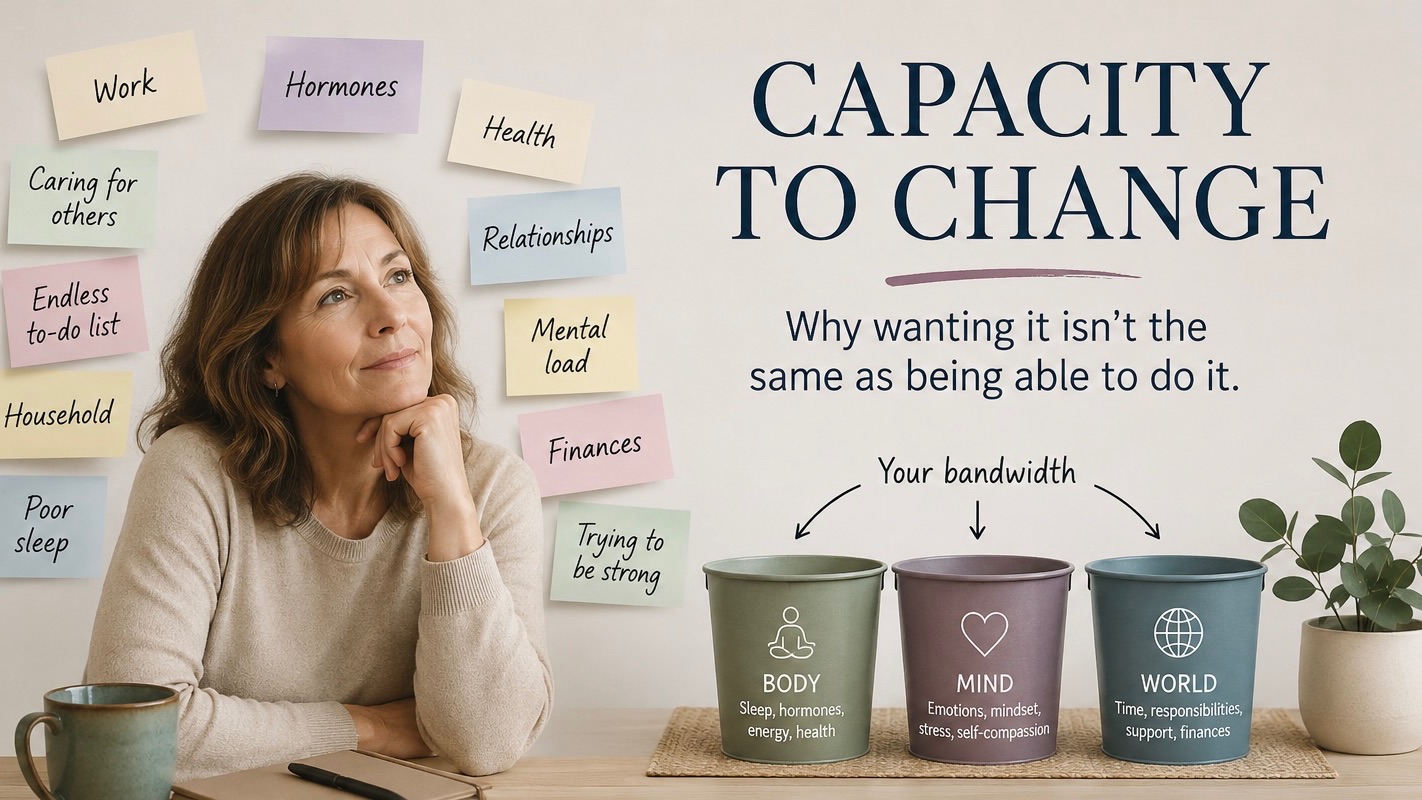
There’s a particular kind of frustration I see often in my work with women during perimenopause and menopause. It usually sounds something like this:
“I know what I need to do. I want to do it. So why can’t I?”
You want to sleep better. You want to move your body, drink a little less, quieten the endless overthinking, feel like yourself again. You’re not lacking desire. If anything, you want it badly. And yet the smallest step, the walk, the earlier night, the conversation you’ve been meaning to have, can feel strangely, disproportionately hard.
And so the self-criticism begins. Maybe I’m lazy. Maybe I just don’t want it enough. Maybe there’s something wrong with me.
I’d like to offer you a different explanation. One that is, I think, both kinder and more accurate.
Two questions we usually ask
When change feels difficult, we tend to reach for one of two explanations.
- The first is about desire: do I really want this? We call this readiness.
- The second is about belief: do I think I can do it? We call this confidence.
Both matter, and you may recognise yourself in either. But in my clinical experience, neither fully explains the women I described above, the ones who really want change, who believe it’s possible, and who still find themselves unable to act.
For them, and perhaps for you, there’s a third question that matters just as much. And it’s one we rarely think to ask.
The question we forget: capacity
Do I currently have the capacity to change?
By capacity, I simply mean this: the resources you actually have available to you right now to take something on and keep it going. Not whether you want to. Not whether you believe you can. Whether, at this moment, you have enough in the tank.
Because here is the truth that gets missed: wanting something and having the capacity to do it are not the same thing. You can want change with your whole heart and still be running on empty.
I find it helps to think of capacity in three parts.
Your body. How well you’re sleeping, where your hormones are, how settled your nervous system feels, your energy, inflammation, your physical health. When your body is depleted, everything else gets harder, including your ability to think flexibly and stay motivated.
Your mind. Your emotional resources: how able you feel to sit with discomfort, to be kind to yourself rather than harsh, to stay steady when things wobble.
Your world. The life around you: time, money, support, and the demands already on your shoulders – work, caring for others, everything you’re quietly holding.
Think of it as bandwidth
A helpful way to picture this is bandwidth, the same word we use for how much a connection can carry at once.
When your bandwidth is generous, change feels possible. You have room to try the new thing, to recover when it doesn’t go perfectly, to keep going.
When your bandwidth is low, even small tasks feel overwhelming. It isn’t that you’ve stopped caring. It’s that there is very little spare capacity left to draw on.
And bandwidth is not fixed. It rises and falls. Poor sleep lowers it. A restful, settled week lifts it. Conflict drains it. Feeling supported restores it.
Why menopause makes this so much harder
Here is the part I most want you to hear, because it matters: if your capacity feels low right now, that makes complete biological sense.
The menopausal transition is one of the most demanding times for your capacity that you will ever experience. Sleep becomes broken. Hormones fluctuate and then decline. Your stress response shifts. Mood and concentration change. Inflammation can rise. And all of this tends to land at exactly the stage of life when you are carrying the most: ageing parents, growing children, demanding work, a full and often invisible load.
So if you have been wondering why change feels harder now than it used to, this is why. It isn’t that you’ve become less capable or less committed. It’s that your capacity has been genuinely, measurably stretched.
A kinder question
Once we understand this, the question changes.
Instead of asking “Why can’t I just do it?” - a question soaked in self-blame - we can ask something far more useful:
“What is limiting my capacity right now?”
That question doesn’t point a finger. It points somewhere helpful. It invites you to look at your sleep, your symptoms, your support, the weight you are carrying and to begin there, rather than simply demanding more of yourself.
You don’t need to push harder
This is the heart of how I work, and the thinking behind a concept I have been developing within my EMBERS® framework, which I call Capacity to Change.
So much of the advice aimed at women in menopause amounts to try harder. But if your capacity is depleted, trying harder is rarely the answer. It usually just adds another layer of exhaustion, and another reason to feel you have failed.
The real work, far more often, is to build capacity first. To restore some of what has been depleted - steadier sleep, a calmer nervous system, more support, a little more room, so that change becomes possible, rather than something you have to force into being.
Readiness gives you intention.
Confidence gives you belief.
Capacity gives you possibility.
When all three are present, change stops feeling like a battle against yourself.
So if you have been quietly believing that you just don’t want it enough, I would gently invite you to put that thought down. You may want it very much. The question worth asking was never whether you want change.
It is whether you have the capacity for it yet and how, kindly and patiently, we might begin to build it.
Embracing Change! Transforming with Kindness!
Content Disclaimer: The information provided in this blog is for informational purposes only and does not constitute professional advice. Please do not rely solely on the content of this blog when making decisions or taking action about your health. For personalised advice and guidance, consult a qualified professional before making any changes based on this information. Menopause CBT Clinic® disclaims all liability and responsibility arising from any reliance placed on any of the contents of this blogpost.
Ready to take control of your emotional wellbeing during the menopause?
Contact us to start your journey and unlock your inner-GLOW. Our team at Menopause CBT Clinic® is here to support you every step of the way.
Send us a message using the form below and we will get back to you as soon as possible.
We hate SPAM. We will never sell your information, for any reason.
